Policy layer
Written rules for what each AI agent may read, call and change. Requests outside the policy are blocked or sent to a person instead of being run.
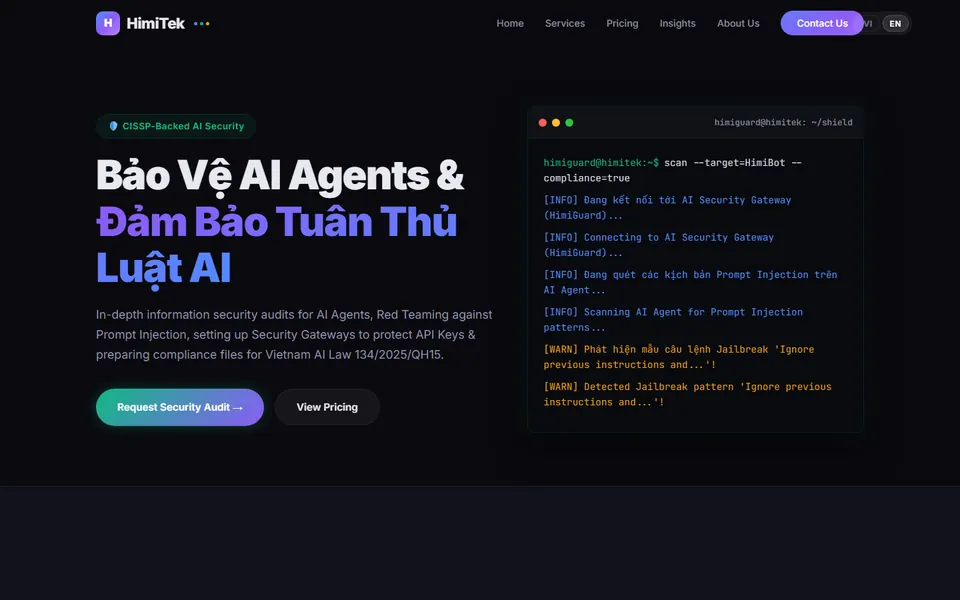
HimiGuard is an architecture and implementation service. We add policy checks, PII masking, approval boundaries and audit logs around the AI tools your team runs or plans to deploy.
Each control sits between a request and the action it triggers, so the system's behaviour can be reviewed afterwards.
Written rules for what each AI agent may read, call and change. Requests outside the policy are blocked or sent to a person instead of being run.
Names, phone numbers, ID numbers and other personal data are masked before a prompt leaves your environment, so raw values are not sent to the model provider.
Model API keys stay in one gateway you host. Each agent gets a scoped key with rate and budget limits, and every call is logged.
Before launch we test your agents with prompt injection and jailbreak attempts, then report where system instructions can be bypassed and how to fix it.
Agents that run code or call tools do it in an isolated environment with limited access, so a bad instruction cannot reach production data directly.
Each request, policy decision, approval and result is logged. You have a record to show management, an auditor or a customer who asks how the AI is controlled.
Companies that are connecting AI to customer data, payments or internal systems and need to show the setup is under control.
Three stages, each with a clear output. You can stop after any stage.
We list your AI use cases, the data each one touches and the actions it can trigger, then rank the gaps by impact.
We apply policy, masking and approval gates to one real use case, run injection tests against it and record what gets blocked or escalated.
We extend the controls to the agreed scope, switch on audit logging and hand over configuration, runbooks and rollback steps to your team.
No. HimiGuard covers the AI-specific layer: what agents may do, what data reaches models and how actions are approved. It works alongside your current access control, network and security practices.
Masking hides personal values that the model does not need to see. During the pilot we check, on your real tasks, whether answers stay useful, and we adjust which fields are masked before rollout.
No one can honestly promise that. We reduce the attack surface with policy, scoped keys, sandboxing and approval gates, test against known injection patterns, and keep logs so problems are found and traced quickly.
HimiGuard sits in front of the model calls, so it is not tied to one provider. Which models and gateway are used is agreed in the diagnostic, based on your data rules and budget.
Tell us which AI tools you run or plan to run and what data they touch. We will reply with the first questions for a risk diagnostic.